“The microbe is nothing; the milieu is everything.”
Pasteur, only late in life, recognized that disease severity stems not just from a pathogen, but from the conditions in which it evolves. The core insight is this: health, whether for organisms or organizations, depends more on the environment than on isolated threats. To affect health, the focus must shift from singular agents to the system as a whole.
Many creatives believe that, due to AI, design tasks are shifting from manual work to cognitive work. And this shift is in a specific direction: from less reflective to more predictive.
Visiting the Dutch Design Week confirmed an obvious fact: most of the creators exhibiting share a common political viewpoint. They openly state this or create artefacts that clearly express it. If you agree with the viewpoint or opinion presented, then you receive tremendous uplift and confirmation. It’s like entering a convention of beekeepers, and all you hear are bees buzzing. Some call this an echo chamber.
Design is a topic on everyone’s mind and will remain so in the coming years. According to the dictionary, the word originally comes from the Latin verb designare, meaning“to mark out, point out, devise, choose, designate, or appoint”. Additionally, it has roots in signare, meaning“to mark,” from signum, meaning“identifying, marking, or sign.” French adopted both these senses from Italian in different forms and passed them to English, which usesthe term in all senses. It has been used since the 1540s to mean “to plan or outline, form a scheme,” and since 1703 to mean “to contrive for a purpose.” The transitive sense of “draw the outline or figure of,” especially for a proposed work, appears from the 1630s, while the meaning “plan and execute, fashion with artistic skill” dates from the 1660s. The intransitive sense of “do original work in a graphic or plastic art” goes back to 1854. Initially, design was all about devising, and the artistic aspect of signing or drawing was incorporated later on.
Wow, even the mainstream is picking up on the effect of strategic design! Check out this episode.
Oh, not that you wonder and cannot find the two and their show. The entire podast was generated by AI, based on a paper I wrote on design capability in companies.
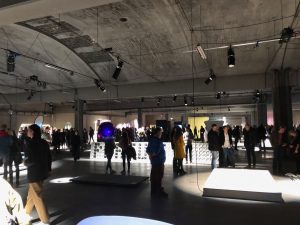
Recently, I took the tour again: a bus took us to the outskirts of Eindhoven, where a deserted, run-down warehouse was hosting the Design Academy’s graduation show. A dark, huge space filled with dramatically lit exhibits of student work and many, many people wandering around, observing the work with a mixture of interest, curiosity, and disbelief.
I was overwhelmed by the sheer size of the show: almost 200 students were graduating and showcasing their work.
Two things immediately came to my mind: what the heck are they showing here, and where the heck do these graduates want to pick up a job?