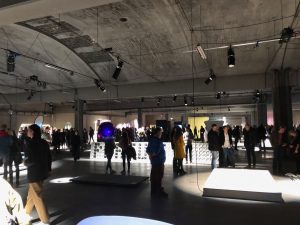
Visiting the Dutch Design Week confirmed an obvious fact: most of the creators exhibiting share a common political viewpoint. They openly state this or create artefacts that clearly express it. If you agree with the viewpoint or opinion presented, then you receive tremendous uplift and confirmation. It’s like entering a convention of beekeepers, and all you hear are bees buzzing. Some call this an echo chamber.
Design is a topic on everyone’s mind and will remain so in the coming years. According to the dictionary, the word originally comes from the Latin verb designare, meaning“to mark out, point out, devise, choose, designate, or appoint”. Additionally, it has roots in signare, meaning“to mark,” from signum, meaning“identifying, marking, or sign.” French adopted both these senses from Italian in different forms and passed them to English, which usesthe term in all senses. It has been used since the 1540s to mean “to plan or outline, form a scheme,” and since 1703 to mean “to contrive for a purpose.” The transitive sense of “draw the outline or figure of,” especially for a proposed work, appears from the 1630s, while the meaning “plan and execute, fashion with artistic skill” dates from the 1660s. The intransitive sense of “do original work in a graphic or plastic art” goes back to 1854. Initially, design was all about devising, and the artistic aspect of signing or drawing was incorporated later on.
When does a musician decide whether they prefer to perform or to compose? Is it a decision of the head or the gut, or do genetics determine which path the musician takes? The fact is that, with a few exceptions, they will either take one direction or the other. It is also a fact that most musicians will make a living as performers.
A long, deep interview that Arne van Oosterom recorded with we, about being in bubbles, being between sides and going into industrial design, to pick up a career at Philips. And a lot about Philips!
Recently, I took the tour again: a bus took us to the outskirts of Eindhoven, where a deserted, run-down warehouse was hosting the Design Academy’s graduation show. A dark, huge space filled with dramatically lit exhibits of student work and many, many people wandering around, observing the work with a mixture of interest, curiosity, and disbelief.
I was overwhelmed by the sheer size of the show: almost 200 students were graduating and showcasing their work.
Two things immediately came to my mind: what the heck are they showing here, and where the heck do these graduates want to pick up a job?
Do you have children? If not, no problem, because you might recall these yourself: the parent conference days! This ‘running-around-at-the-school-campus-and-looking-for-the-room’ where teachers are waiting for parents and their school-kids. Depending on the pupils’ ‘performance level’, the numbers of meetings were few or many and likewise torture or purely a matter of duty.
They made the appointment together, father and daughter, to find out what the bachelor’s program in design management is all about. Apparently, she was looking for a program that would allow her to pursue her affinity for creativity, whereas Dad seemed to have something in mind that would lead to a solid job qualification and be of real value in the economy as he knows it. That’s why the ‘management’ in the program’s title seemed to ease him a bit, and accordingly, he was very curious to find out what the heck ‘design’ had to do with it.
We all want superstars, supermodels – or an ‘idol’!
Millions of TV viewers are following seemingly ordinary people in their battle against competition and aim to shine in the limelight – and with that to gain fame and fortune! It seems to be irrelevant what these people actually do; they just have to convince ‘the jury’ with features others don’t have: if you’re not the prettiest, then be the ugliest; if you can’t sing like Pavarotti, why not name the cat food brand by sniffing at your kitties’ poo? To be at the top of the ladder, it’s essential to be unique and deliver uniqueness; it doesn’t matter if the uniqueness doesn‘t add to anything; it just has to add to yourself. more…
It was one of these design events, like many others in Germany: after the panelists had given their speeches, it was time for the Q&A! Finally, the audience had the chance to express their opinions, and some immediately took the opportunity. It was just a question of minutes for the question to be asked – the one on the status of design within companies! more…
It starts to irritate me, the more and more I’m confronted with it: the job title ‘design manager’.
And the longer I spin my head around it, the more this title ends up being an oxymoron (Greek for ‘oxy’ = sharp and ‘moron’ = foolish) – next to this, it’s also not clear to me, which part in the title is the ‘sharp’ one, which the ‘foolish’! more…